Continuous Control Assurance shifts Internal Audit from periodic sampling to continuous control and evidence validation, improving visibility, speed, and consistency in assurance. It reduces manual effort and helps organizations stay continuously ready for audits and regulatory expectations. ANA accelerates this shift by enabling continuous assurance within secure enterprise environments.
A global bank’s compliance team recently spent four weeks reconstructing audit evidence for a regulatory exam—evidence a continuous assurance system would have generated automatically, in real time. Traditional assurance models built around periodic reviews, manual walkthroughs, and retrospective testing are struggling to keep pace with modern enterprise risk.
As regulatory expectations increase and transaction volumes grow, organizations require assurance models capable of operating continuously rather than periodically. This shift reflects the broader future of risk management and internal controls, where assurance becomes continuous rather than episodic.
Continuous Control Assurance (CCA) enables enterprises to continuously validate controls, evaluate evidence, and identify operational anomalies in near real time.
According to the National Institute of Standards and Technology (NIST), continuous monitoring is essential for maintaining ongoing awareness of security vulnerabilities and operational risk in dynamic enterprise environments.
The Core Constraint Behind Traditional Internal Audit
The biggest challenge facing Internal Audit today is scalability.
Most assurance functions still rely heavily on manual testing, fragmented evidence collection, and reviewer-dependent interpretation. As regulatory expectations and operational complexity grow, this model becomes increasingly difficult to sustain.
Sampling Risk
Traditional audits often test only a subset of transactions, limiting visibility into the broader control environment and increasing the risk of missed exceptions or control failures.
The Findings Gap
Control failures are often identified weeks or months after occurrence, delaying remediation and contributing to recurring findings across audit cycles.
Capacity Drain
Manual walkthroughs, evidence collection, and repetitive documentation consume significant audit capacity, reducing the time available for strategic risk evaluation and governance priorities.
Why Traditional Assurance Models Are Failing Boards
Boards today expect faster visibility into risk, stronger evidence quality, and greater confidence that controls are working continuously, not just during periodic reviews. In highly regulated environments, traditional assurance cycles are struggling to keep pace with the speed of operational and regulatory change.
Defining the Continuous Control Assurance Model
Continuous Control Assurance (CCA) shifts assurance from periodic testing to continuous validation. Instead of reviewing controls only during scheduled audit cycles, organizations continuously evaluate control effectiveness, transactional activity, policy adherence, and operational anomalies across enterprise systems.
The objective is not simply faster audits, but a more resilient assurance model capable of maintaining ongoing visibility into risk exposure and control performance.
Continuous Monitoring vs Continuous Auditing
While often used interchangeably, Continuous Monitoring and Continuous Auditing serve distinct roles within the assurance ecosystem.
| Continuous Monitoring | Continuous Auditing |
| Performed by operational or compliance teams | Performed independently by Internal Audit |
| Focuses on day-to-day control execution | Focuses on evaluating control effectiveness |
| Identifies issues during operational activity | Validates whether controls remain reliable over time |
| Supports immediate remediation | Supports assurance and governance reporting |
| Embedded within business operations | Maintains independent assurance responsibilities |
Policy-Aware AI Workers and Real-Time Assurance
Modern CCA environments increasingly use policy-aware AI systems that can evaluate transactions, validate evidence against controls, identify anomalies, and detect control drift in near real time.
By continuously evaluating operational activity against enterprise policies and regulatory requirements, organizations gain faster visibility into potential risk exposure and control failures before they escalate into larger findings.
Automating Audit-Ready Evidence Collection
Traditional evidence collection remains one of the most time-intensive aspects of assurance operations.
CCA streamlines this process by continuously generating testing records, evidence mappings, transaction logs, and policy references as operational events occur. This creates audit-ready documentation continuously instead of recreating evidence manually during review cycles.
The Architecture of Trusted AI for Internal Audit
For regulated enterprises, trust is foundational to AI adoption within Internal Audit and Risk functions. Assurance systems must be designed around transparency, explainability, traceability, and governance alignment to ensure defensible and reliable outcomes.
Transparency, Explainability, and Accountability
AI-driven assurance systems must produce outputs that are explainable and traceable. Organizations need visibility into how conclusions were generated, which evidence was evaluated, and how exceptions were identified. This is essential for maintaining confidence in assurance outcomes across audit, risk, and regulatory functions.
Secure Enterprise AI Deployment
For banks and regulated institutions, assurance infrastructure cannot rely on uncontrolled public AI environments. Enterprise assurance platforms must operate within enterprise-controlled infrastructure such as private cloud or on-premises deployments to maintain security, compliance, and data residency requirements.
Full IT Governance and Data Integrity
Security and IT teams play a critical role in validating assurance infrastructure before deployment. This includes encryption validation, access governance, infrastructure reviews, and enterprise security approvals to ensure data integrity and regulatory alignment.
Tamper-Evident Logs for SOX Compliance
Traceability is essential for SOX and regulated assurance environments. Tamper-evident logs help organizations maintain defensible evidence chains by recording testing activity, policy references, evidence access, and remediation actions across assurance workflows.
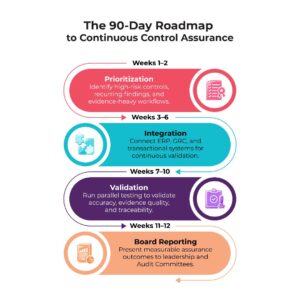
Governance and the Human Factor in AI-Powered Audit
As AI adoption grows within Internal Audit and Risk functions, governance remains critical to maintaining trust, accountability, and regulatory alignment.
Organizations increasingly require leaders who understand both enterprise risk management and AI governance as assurance environments become more technology-driven.
Programs such as ISACA’s Advanced in AI Risk™ (AAIR™) are emerging as important benchmarks for professionals managing AI risk and governance in regulated environments.
By reducing repetitive activities such as evidence collection and documentation workflows, auditors gain greater capacity to focus on strategic risk analysis, control evaluation, and governance priorities.
What Changes When Assurance Becomes Continuous
Continuous Control Assurance marks a shift from periodic audit cycles to continuous validation of controls and evidence. It reduces reliance on manual sampling and improves the speed, consistency, and reliability of assurance across enterprise environments.
As assurance becomes continuous, organizations gain stronger visibility into control effectiveness and greater readiness for regulatory examinations. This evolution is closely aligned with Continuous Controls Monitoring in banking, where real-time visibility replaces retrospective assurance cycles.
ANA, a purpose-built continuous assurance capability designed for regulated enterprise environments, supports this shift by helping operationalize continuous control monitoring and evidence validation within existing enterprise systems—bridging the gap between concept and execution.
Reach out at info@anaptyss.com to explore how ANA helps strengthen control visibility, governance, and regulatory readiness.